It started with a whisper, a quiet siphoning of digital crown jewels. And by the time GitHub confirmed it on May 20, 2026, the damage was already being cataloged. A single, seemingly innocuous Visual Studio Code extension, lurking on an employee’s machine, had become the ghost in the machine, unlocking access to nearly 3,800 internal GitHub repositories. The timing was almost theatrical: hours before GitHub’s announcement, the familiar moniker of TeamPCP appeared on a cybercrime forum, offering up “GitHub’s source code and internal orgs” for a starting bid of $50,000.
This isn’t just another headline about a company getting hacked. This is a stark, unsettling illustration of a fundamental architectural shift happening in software development and its security implications. The Integrated Development Environment (IDE), once a neutral workspace, is fast becoming the most privileged — and most vulnerable — endpoint in the entire enterprise.
The New Front Line: Your IDE
The initial vector? A poisoned VS Code extension. It’s a chillingly elegant attack. We trust these tools. We install them without a second thought, often driven by the promise of increased productivity or specialized functionality. But when one of those extensions is subverted, it doesn’t just affect a single user; it inherits their permissions, their access, their implicit trust. And in the case of a company like GitHub, that trust extends to a treasure trove of intellectual property.
GitHub’s response, while swift, underscores the severity: isolating the endpoint, removing the malicious version, and initiating a massive rotation of critical secrets. But the core question remains: how much was already gone? The actor’s claim of 3,800 repositories is “directionally consistent” with GitHub’s findings. That’s a polite way of saying, “Yeah, they probably got a lot of our stuff.”
Who is TeamPCP and Why Should You Care?
TeamPCP isn’t a new player. This threat actor has a growing rap sheet in the developer tooling ecosystem. Their previous escapades include compromising Aqua Security’s Trivy scanner, the Checkmarx KICS project, and the LiteLLM Python library. This isn’t random noise; it’s a targeted campaign against the very infrastructure that builds modern software. They understand that compromising a widely used tool is a far more efficient way to gain broad access than brute-forcing individual credentials.
This incident, at its heart, is a supply chain attack that has landed squarely in the developer’s lap. The blast radius isn’t measured in compromised servers anymore; it’s measured in the sensitive data, proprietary code, and intellectual property that can be quietly exfiltrated from a developer’s workstation.
Unanswered Questions Lurking in the Codebase
The incident forces a brutal reckoning for security teams: if a single extension can do this, what else is lurking in your environment? The unanswered questions are precisely the ones that should keep CISOs up at night.
- How do you even know what extensions are installed across thousands of developer machines?
- Who is responsible for vetting and approving them?
- If an extension turns malicious, can you detect the subtle exfiltration of data, or will you just see the headline?
The blast radius isn’t measured in machines — it’s measured in repositories, tokens, and the secrets that live inside them.
This is where we’re heading. The IDE is the new endpoint. It’s where code is written, where secrets are often embedded (even if unintentionally), and where privileged access is granted. A single decision about installing a VS Code extension can now have catastrophic consequences. It’s a paradigm shift that demands a fundamental rethinking of how we secure development environments.
Beyond the Breach: Proactive Defense
While GitHub digs through its logs, the rest of us are left to ponder our own vulnerabilities. The implications here extend far beyond GitHub itself. Every organization that relies on third-party extensions for its developer workflows is exposed.
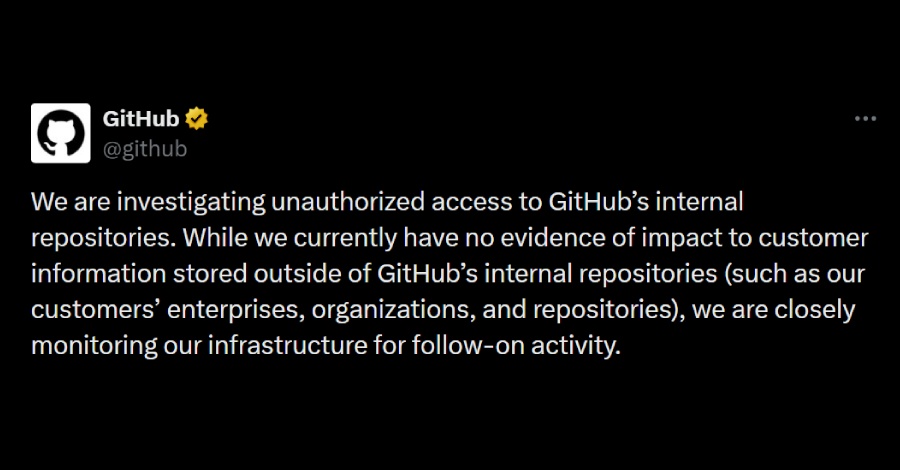
GitHub stated it has no evidence of impact to customer information stored outside of its internal repositories — customer enterprises, organizations, and repositories included.
This statement is, of course, the company’s official line. And for now, we’ll take it. But the reality of supply chain attacks is that the initial foothold is often just the beginning. The question isn’t if this will happen elsewhere, but when, and how prepared you’ll be when it does.
🧬 Related Insights
- Read more: Instructure Breach: 275M Records Compromised, ShinyHunters Claims
- Read more: What is a CVE?
Frequently Asked Questions
What does this GitHub breach mean for my code?
This breach specifically targeted GitHub’s internal repositories. While your customer data is reported to be unaffected, it highlights the risks of malicious code being introduced through development tools like VS Code extensions. You should review your own development toolchain’s security.
How can I protect my development environment from similar attacks?
Inventory and vet all IDE extensions rigorously. Implement strict policies for their installation, ideally allowing only signed and business-approved extensions. Regularly rotate credentials and secrets accessible from developer endpoints.
Will this type of attack become more common?
Unfortunately, yes. The success of supply chain attacks against developer tools like VS Code extensions makes them an attractive vector for threat actors seeking broad access to valuable codebases and sensitive data.